01 Lindsay Gaze shooting a lay-up with Albert Leslie (10) trying to block the shot (L. Gaze)
LINDSAY GAZE
6 feet 0 inch (183 cm) Guard
1960, 1964, 1968 Olympic Games
The Australian team was enjoying a very good tournament in the Olympic Qualification Tournament for the 1964 Tokyo Olympic Games. The tournament was being held in the Japanese city of Yokohama. The Australians had won three of their first four games and were confident of defeating Taiwan in their fifth game. But Taiwan had other ideas. Taiwan tied the game at 62 all with twenty seconds remaining in the game. The Australian team point guard Lindsay Gaze was not happy. The refereeing had been very inconsistent and frustrating. But now was the time to play. Lindsay had possession of the ball and dribbled it around playing “keeping off” and working for the last shot of the game. “We win or it’s a draw,” thought Lindsay. He was half thinking about what the referees might call but that was out of his hands. Lindsay takes up the story, “As the clock wound down I decided to go it alone realising the worst that could happen was a tie, but after finding my way through some traffic pulled up for a jump shot near the baseline with four seconds left on the clock and good fortune allowed the ball to drop into the basket.” Australia had won! The players raced on the court and chaired Gaze off on their shoulders. Team-mate Michael Ah Matt was so enthusiastic that he ran into Lindsay’s elbow and ended up with four stitches in his head. Lindsay recalls, “I don’t remember collecting anyone with my elbow after the game.” But Lindsay had done what he had always been able to do. Make the big play when the game was on the line!Lindsay John Casson Gaze was born in Adelaide on August 16, 1936.Lindsay was the youngest of three sons and his family moved to Melbourne when he was a boy.“I was bloody hopeless at sport. I was clearly the most uncoordinated, awkward and untalented in the family. But I always wanted to play,” he recalls.Lindsay’s sporting career started in Australian Rules where he played for Prahran in the Victorian Football Association (AFA).He was named as a reserve in an amateur exhibition Australian Rules match at the 1956 Olympic Games. Introduced to basketball by his brother Barry in 1951 it was not long before long Lindsay was playing for the Melbourne Church Team under the guidance of Ken Watson the 1956 Australian Olympic Coach.Lindsay was drawn between football and basketball but when he was appointed Stadium Manager for the Victorian Basketball Association (VBA) in 1958 his decision was made for him.Lindsay was selected on the Australian Olympic Men’s Basketball Team for the 1960 Rome Olympics. The team was the first Australian Men’s National Basketball team to play overseas in a FIBA event. The Australian Team did not get past the Qualification Tournament in Bologna, Italy. However the experience of those games and other games on the way to the Olympics had a profound influence on Lindsay and his team-mates.
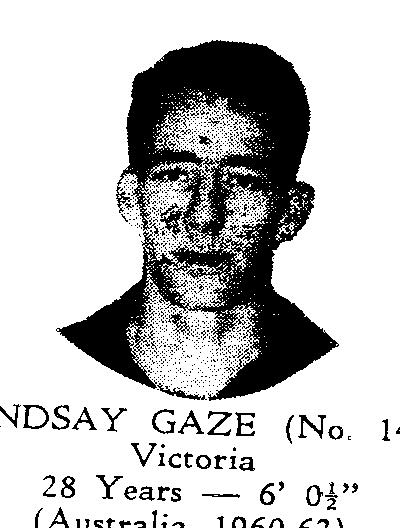
02 Lindsay Gaze in his Victorian uniform (R. Watson)Lindsay was selected to play on the Australian Team for the 1962 World Championships in the Philippines but a political dispute (whereby the Philippines Government refused visas for several communist countries) prevented the tournament being officially recognised. An Invitation Tournament was arranged between the countries that were there (including the USA) and Lindsay and Bill Wyatt were named to the All Star Team despite the fact that Australia did not win a game.The 1964 Tokyo Olympics were a defining moment in Lindsay’s basketball career (as well as for basketball as a game in Australia) as the Australian Team surprised everyone by gaining second place in the Yokohama Olympic Qualification Tournament where they won all their games bar one before proceeding to the Olympic Finals in Tokyo. The Australians went on to defeat Peru, Korea, Japan, and Mexico to finish 9th in the 1960 Olympic Games.The results in Tokyo and the media coverage put the Australian Basketball Team and players such as Lindsay, Bill Wyatt, Michael Ah Matt and John Heard and others on the Australian sporting map.Lindsay was now enjoying basketball celebrity status in Australian Club basketball with the mighty Melbourne Church Basketball Team. Lindsay’s skill, tenacity, leadership, and all-round ability on offense and defence made him one of the nation’s premier players. His high stepping run, outstanding balance and fundamentals coupled with a reliable shot backed by his leadership made him in his time one of the mainstays of the Australian Men’s Team. His outstanding knowledge of the game in some ways set him apart from his fellow players as he played “like a coach” and led from the front. He could often be seen “coaching” the team while he was a player.03 Lindsay Gaze scoring a lay-up (L. Gaze)04 Lindsay Gaze the coach (Basketball Australia)Lindsay Gaze (14) helps Mike Dancis (11) in the 1964 Olympic Games (IOC)Lindsay Gaze being chaired off after scoring the winning basket agaisnt Taiwan (IOC)Lindsay Gaze leads the 1968 Olympic Team onto the floor at the 1968 Olympic Games Qualification Tournament (A. Leslie)Lindsay Gaze scoring a lay-up basket four photographs (L. Gaze)No 15 Lindsay Gaze 1No 15 Lindsay Gaze in the Victorian Basketball Team (R. Watson)
 trying to block the shot (L. Gaze).jpg)
.png)
.png)
.png)
 helps Mike Dancis (11) in the 1964 Olympic Games (IOC).JPG)
.png)
.png)
.jpg)
.png)